
Authority Backlinks: What They Are and How Sites Actually Earn Them
An authority backlink is a link from a site that is trusted and relevant in your field. Here is what Google actually measures, why DR and DA are not it, and how authority is built.
By DigitalUs Media teamPublished Updated 6 min read
Authority backlinks are links from websites that are well established, trusted and relevant to your topic: a respected trade publication, a university, a government body or a well-known company in your field. One of them can do more for a site than hundreds of links from sites nobody visits.
This guide explains what “authority” means for links, what Google actually measures (and what it doesn’t), and how sites earn links like these. We’ll use our own site as the example, because its link profile shows the difference between authority and volume better than any made-up case.
What is link authority?
“Link authority” is the idea that a link passes some of the trust and importance of the linking page to the page it points to. A link from a page that many other trusted pages link to carries more weight than a link from a page with no links of its own.
Google’s version of this idea is PageRank. Its guide to ranking systems lists link analysis systems and PageRank among the ways it understands how pages relate to each other, and describes PageRank as one of the core ranking systems Google used when it first launched.
What Google doesn’t publish is a single “authority score” for your site. That matters for the next question.
DR, DA and other authority scores are not Google’s
Domain Rating (Ahrefs), Domain Authority (Moz) and Authority Score (Semrush) are third-party metrics. Each tool crawls the web, counts links and turns them into a 0–100 score. They’re useful for comparing sites and spotting trends, but Google doesn’t use them.
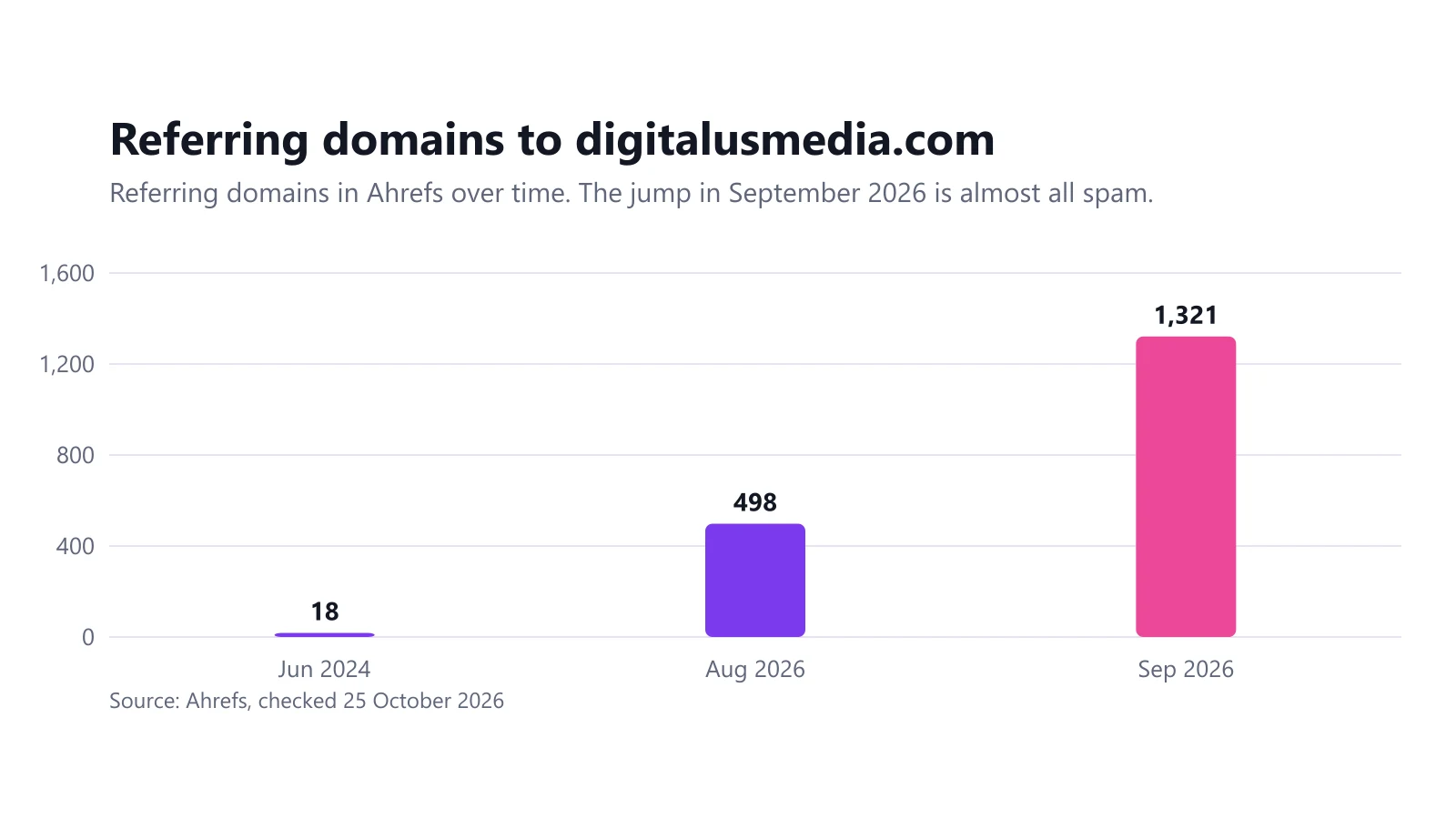
Our own site shows why they are only a rough guide. In June 2024, Ahrefs gave digitalusmedia.com a Domain Rating of 4.1. By October 2026 it was 0.5, even though the number of sites linking to it had grown from 18 to more than 1,200. Almost all of that growth was spam, and the tool rightly gave it no weight.
Our rule of thumb: use these scores to filter, never as the goal. “Get us DR 50 links” is a brief that leads straight to bought links.
True or false: do backlinks build authority?
Mostly true, with an important condition. Google’s explanation of how Search works and its ranking systems guide both describe links as a way Google discovers pages and understands which ones are useful. A link from a relevant, trusted page is a vote for yours.
The condition: the link has to be one that Google counts. Google’s spam policies say that links intended to manipulate rankings, such as bought links, link exchanges at scale and automated links, are link spam. Those links are ignored at best. At worst, a site that builds them gets a manual action.
So backlinks build authority when they’re earned. Buying “authority backlinks” from a list is the opposite of what the phrase means.
Link relevance vs authority: which matters more?
Both matter, but in our view relevance comes first.
- A relevant link comes from a site about the same subject or audience as yours. It sends visitors who might actually become customers, and it makes sense as a reference.
- An authoritative link comes from a site that is widely trusted and linked to.
The best links are both: a leading publication in your industry citing your research. When you have to choose, a link from a small but respected site in your niche is usually worth more than one from a big general site that has no reason to mention you.
What are authority sites?
Authority sites are websites that other sites in a field regularly cite. They tend to share a few traits:
- They publish original information that others quote: research, data, documentation, news.
- Real people read them. They get search traffic and direct visits, not just links.
- They’ve been around for years and have a consistent topic.
- They link out carefully, and mark paid or sponsored links with
rel="sponsored"orrel="nofollow", as Google asks sites to do.
That last point is a useful test. A site that sells links to anyone who pays isn’t an authority site, whatever its score says.
Our own link profile: 1,219 domains, 3 that count
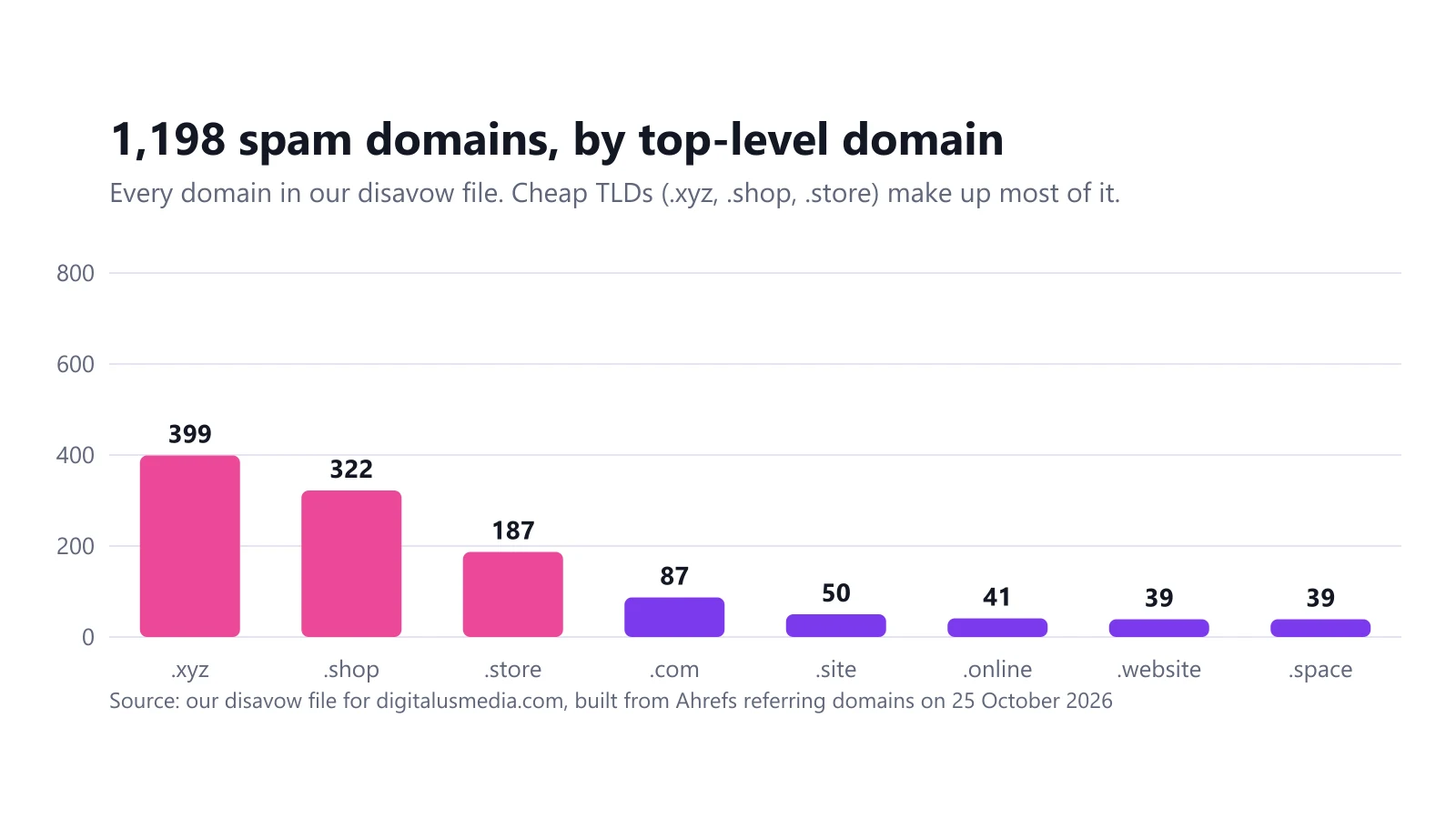
On 25 October 2026, Ahrefs listed 1,219 live referring domains for digitalusmedia.com. When we sorted them one by one, only 3 were genuine sites that had linked to us on their own: cmswire.com, theglobe.net and atspace.com. Of those, cmswire.com was the only real editorial link from an established publication.
The other 1,198 came from link-seller networks, numbered .xyz domains and fake “SEO checker” sites, with anchors like “Premium Authority Link Building for digitalusmedia.com”. The full breakdown is in our negative SEO attack case study, and the method we used to sort them is in how to find toxic backlinks.
The lesson for authority link building is simple: a big referring-domain count says nothing about authority. One editorial link from a site like cmswire.com is worth more than everything else in that list combined.
Digital authority building: how sites earn authority backlinks
Authority link building is slow because the links have to be given, not taken. These are the approaches we’d start with:
Publish something worth citing
Original data, a clear explanation of a hard topic, a free tool or a well-maintained resource. Journalists and other writers link to sources. Our own spam-link case study is an example: it’s built on our real numbers, which is what makes it citable.
Be a source for journalists and writers
Answer questions from reporters in your field, offer comments on news in your industry, and make it easy to quote you: a named expert, a short bio, a clear statement.
Use the relationships you already have
Partners, suppliers, associations, event organizers and clients you’ve worked with often have a natural reason to link to you: a partner page, a case study, a speaker profile. These links are relevant by definition.
Earn links to the right pages
Most links will go to useful content, not to your service pages. Link from that content to your services, so the authority it earns flows through your site.
Link building beyond domain authority: what to look at instead
When you assess a potential link, look past the score:
- Would a real reader click it? If the link would never send a visitor, it probably isn’t worth much.
- Is the site about your topic or audience?
- Does the site have real traffic, or only links?
- Does it sell links? If it has a “write for us” page with a price list, Google’s link spam policies apply.
- Is the link editorial? Did someone choose to link because your page helps their readers?
If you can answer yes to the first, second, third and fifth questions, the link is worth having whatever its DR.
Where to start
If your link profile is thin, don’t start by chasing links. Start by checking what you already have, removing risk if there is any, and creating one or two pages that deserve to be cited. That’s how we approach our link building service: fewer links, all of them earned, and none of them bought.
Related guide: how link building differs between countries on jorgehorst.com
Frequently asked questions
What are authority backlinks?
Links from websites that are well established, trusted and relevant to your topic, such as respected industry publications, universities, government sites or well-known companies in your field. One of them is usually worth more than hundreds of links from unknown sites.
True or false: backlinks build authority?
Mostly true. Google describes links as one of the signals it uses to understand how pages relate and which ones are useful. But only links that are earned and relevant help; bought or spammy links are ignored or can lead to a manual action.
Is Domain Rating or Domain Authority a Google metric?
No. Domain Rating (Ahrefs) and Domain Authority (Moz) are third-party scores that estimate link strength. Google doesn't use them. They are useful for comparing sites, but raising them is not a goal in itself.
What matters more, link relevance or authority?
In our view you want both, but relevance comes first. A link from a respected site in your own field sends the right visitors and makes sense to Google; a high-scoring link from an unrelated site often does neither.
How many authority backlinks do I need?
There is no fixed number. It depends on how established the sites you compete with are. For a small business, a handful of genuine links from relevant sites usually makes a visible difference.
Related guides
Link Building and Negative SEO
How to Find Toxic Backlinks (and Which Ones Actually Matter)
Export your referring domains, then look at anchors, domain names, traffic and timing. Most bad links can be ignored; a few patterns need action.
5 min read
Link Building and Negative SEO
Our Site Was Hit by a Negative SEO Attack: 1,198 Spam Domains and a 98% Drop in Impressions
In September 2026 our own site went from 498 to 1,321 referring domains, and Google impressions fell from 1,393 to 24. Here is the data and what we did.
6 min read
Link Building and Negative SEO
How to Create and Upload a Google Disavow File (With Examples)
A disavow file is a plain .txt list of links you want Google to ignore. Here is the format, real examples, how to upload it, and when not to use it.
6 min read
Link Building and Negative SEO
Negative SEO: What It Is, Whether It Works and How to Protect Your Site
Negative SEO is any attempt to hurt another site's rankings from the outside. Google says it ignores most of it. Our own data shows why small sites should still watch for it.
5 min read