Link building is how a website earns links from other sites, and this section also covers the other side of it: recognizing spam links, judging negative SEO and deciding whether a disavow file is needed. It’s for business owners and marketing managers who want links that count, and who want to know what to do when their backlink profile fills up with junk.
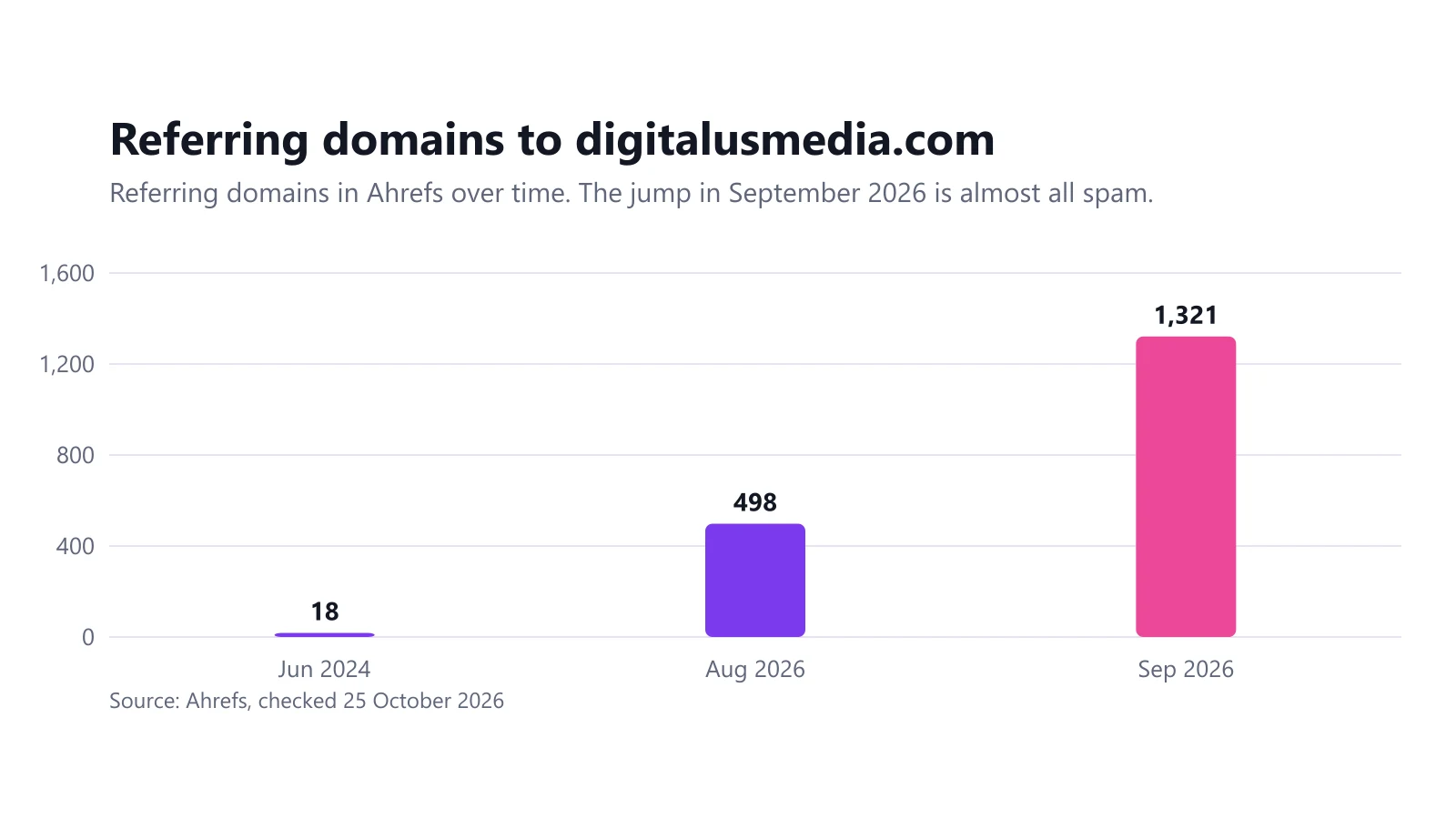
Our own site runs through these guides as the example. In September 2026, digitalusmedia.com went from 498 to 1,321 referring domains in about a month, almost all of it spam, and its Google impressions fell from 1,393 to 24 in the same month. We can’t prove the links caused the drop, and the guides say so.
Where to start
Read them in this order, from what a good link is to what to do about bad ones:
- Authority backlinks explains what makes a link worth having, why DR and DA are not Google metrics, and why relevance comes before authority.
- Our negative SEO attack case study is the full record of the spam wave on our own site, with the anchor patterns, the Search Console numbers and what we did.
The decisions that come up most often
Judging links by a third-party score. Domain Rating, Domain Authority and similar scores come from SEO tools, not from Google. Our own site shows how little a count says: its referring domains grew from 18 in June 2024 to more than 1,200 by October 2026, while its Ahrefs Domain Rating fell from 4.1 to 0.5, because almost all of the growth was spam. Ask instead whether a real reader would click the link and whether the site is about your topic.
Paying for shortcuts. Google’s spam policies list buying or selling links for ranking purposes, excessive link exchanges, large-scale guest posting with keyword-rich anchors and automated link programs as link spam. Since the December 2022 link spam update, Google says SpamBrain can detect both sites buying links and sites used to pass them, and neutralize those links. A bought link is likely to be worth nothing even if it never leads to a manual action.
Disavowing too early or too broadly. Google’s disavow documentation says most sites will not need the tool, and that it can harm performance if used incorrectly. Rule out other causes of a traffic drop first: the Manual Actions and Security Issues reports, the Page indexing report and Google’s Search Status Dashboard for updates rolling out at the time. When a disavow file is justified, work at the domain level, and leave any domain you hesitate over in a “review” list rather than in the file.
Upload details that trip people up. The disavow tool doesn’t support Domain properties, so the file goes to a URL-prefix property, and each upload replaces the previous list completely.
Not watching at all. A monthly look at new referring domains, or an alert in your backlink tool, would have shown our own spike within days instead of weeks.
In our view, a few relevant links that other sites chose to give will do more for a small site than any amount of cleanup, which only removes risk.
Our link building and link cleanup service covers both sides: audits and disavow files when the data justifies them, and earning links without link schemes.