
Link Building Strategies That Still Work (and the Ones That Get You Penalized)
The link building strategies that still work all come down to giving other sites a reason to link. Here are eight of them, and the shortcuts that break Google's rules.
By DigitalUs Media teamPublished 6 min read
The link building strategies that still work all do the same thing: they give another site a good reason to link to you. Original data, useful resources, expert comments for journalists and genuine partner relationships earn links that last. Paying for links, swapping them at scale or generating them automatically breaks Google’s spam policies.
Below are eight strategies we’d use, the types of backlinks they produce, and the tactics to avoid. The warning examples come from our own site, which was flooded with exactly the kind of links you don’t want.
Why link building still matters
Google uses links to discover pages and to understand how pages relate to each other. Its ranking systems guide lists link analysis and PageRank among its systems. Links are not the only signal and often not the most important one, but a site with no links from anywhere is hard for Google to trust.
What has changed is how well Google handles manipulated links. Its December 2022 link spam update describes SpamBrain detecting both sites that buy links and sites used to pass them, and neutralizing those links. A bought link today is likely to be worth nothing, even if it never causes a penalty.
Types of backlinks
Not all links are equal. The main types, roughly from most to least valuable:
| Type | Example | Value |
|---|---|---|
| Editorial | A journalist cites your research in an article | Highest: chosen by an editor, usually relevant |
| Resource or reference | A university guide links to your free tool | High: stays for years |
| Partner and supplier | A software vendor lists you as an implementation partner | Good: relevant by definition |
| Community | A helpful answer in an industry forum that links to your guide | Moderate: often nofollow, but sends visitors |
| Profiles and directories | Chamber of commerce or trade association listing | Low but legitimate |
| Sponsored | A paid placement marked rel="sponsored" | No ranking value by design, can still bring traffic |
Google asks sites to mark paid links with rel="sponsored" and user-generated links with rel="ugc" (see qualifying outbound links). That’s fine: these links still bring visitors and brand exposure, they just don’t pass ranking signals.
Link building strategies that still work
1. Publish original data
Data is the most reliably cited kind of content. Survey your customers, analyze data you already have, or document something you measured yourself. Writers need numbers, and they link to where the numbers came from.
Our own example: our negative SEO attack case study is built on our real Ahrefs and Search Console data. We plan to share it with SEO newsletters and communities, because a real dataset on a spam link attack is something those writers can reference. We’ll report how many links it earns.
2. Create a resource people keep coming back to
A checklist, a calculator, a glossary, a template, a clear guide to a confusing process. Resources earn links slowly but keep earning them, because people find them when they write about the topic later.
The test we use: would someone bookmark this page? If not, it won’t be linked to either.
3. Be a source for journalists
Journalists and bloggers regularly look for experts to quote. Answering those requests quickly, with a short and specific comment, can earn editorial links from publications you couldn’t reach otherwise. Only answer where you have real expertise; generic answers don’t get used.
4. Digital PR around real news
If your company does something newsworthy (a study, a launch, an event, a strong opinion on an industry change), pitch it to the publications your customers read. Keep the pitch short and lead with what’s new for their readers, not with your company.
5. Ask for the links your relationships already justify
Many businesses have links waiting for them:
- Partners and suppliers with a “partners” or “customers” page.
- Associations and chambers of commerce you belong to.
- Events you sponsored or spoke at.
- Clients who might publish a case study or testimonial page about working with you.
These are legitimate because the relationship is real. Paying for the link, or making a link a condition of a deal, is not.
6. Resource and broken-link outreach, done honestly
Find pages that list resources on your topic, or pages linking to a resource that no longer exists, and let the author know about your page if it genuinely helps their readers. Keep it personal, short, and accept that most won’t reply.
What turns this into spam is scale and pressure: hundreds of templated emails, offers of payment, or “link swaps”.
7. Take part in your community
Answer questions in industry forums, contribute to open-source projects, speak at meetups, write for publications in your field. Many of these links are nofollow or ugc. That’s fine: they put your name in front of the people who later write the editorial articles.
8. Build a free tool
A small calculator or checker solves a problem and gets linked from articles about that problem. It needs maintenance, so only build one you can keep working.
Link building tactics that get you penalized
Google’s spam policies define link spam as links intended to manipulate rankings. These are the tactics that fall under it:
- Buying or selling links that pass ranking credit, including “link packages”, paid guest posts without
rel="sponsored", and exchanging goods or services for links. - Excessive link exchanges (“link to me and I’ll link to you”), and partner pages that exist only to swap links.
- Large-scale guest posting or article campaigns with keyword-rich anchor text.
- Private blog networks (PBNs): sites created or bought only to link to other sites.
- Automated programs or services that create links to your site.
- Requiring a link as part of a terms of service or contract, without letting the site owner qualify it.
- Low-quality directory or bookmark sites and hidden or keyword-stuffed links in widgets and footers.
The consequences range from Google ignoring the links (you paid for nothing) to a manual action that removes pages or the whole site from results until you clean up.
What spam links look like from the receiving end
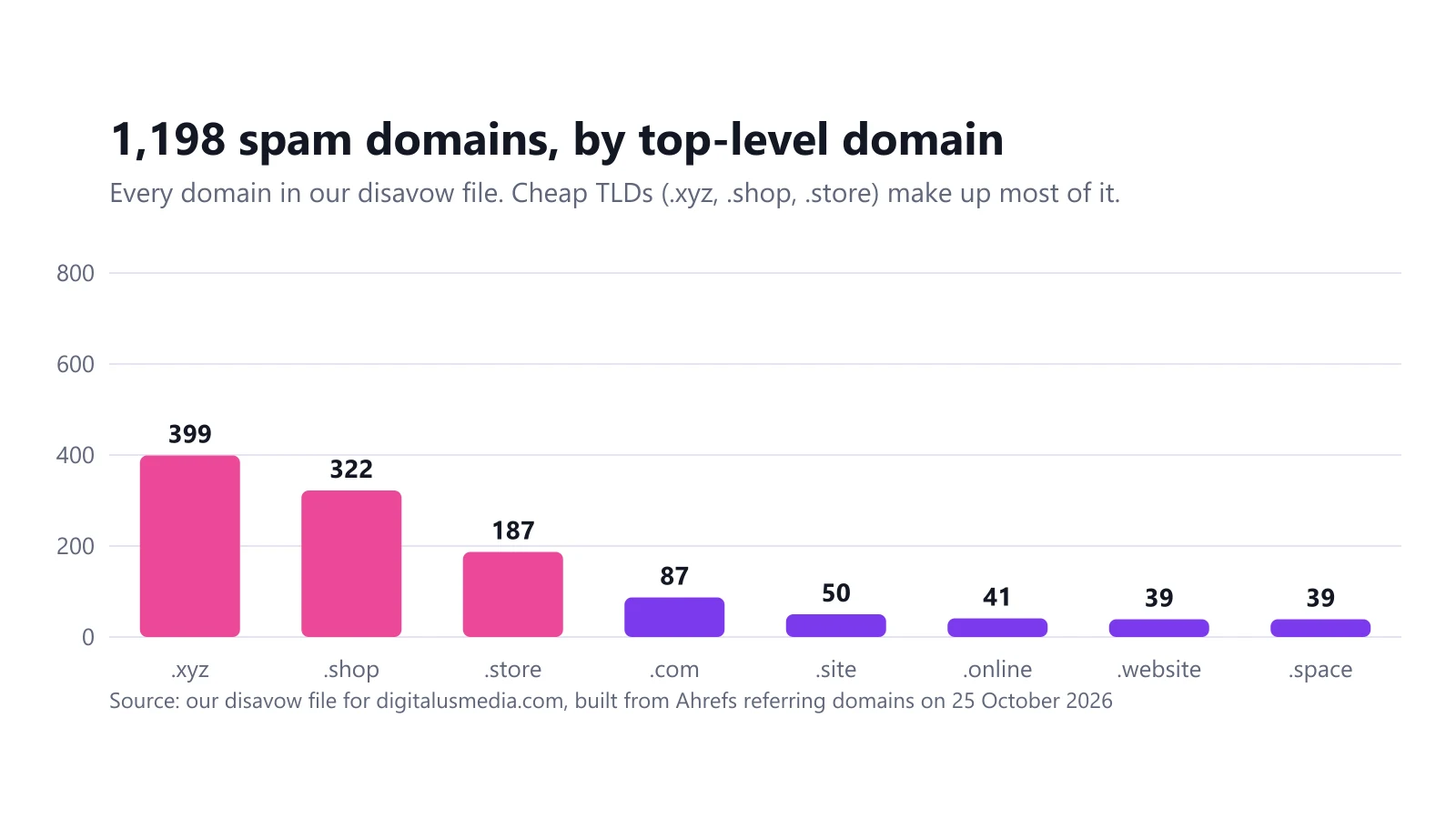
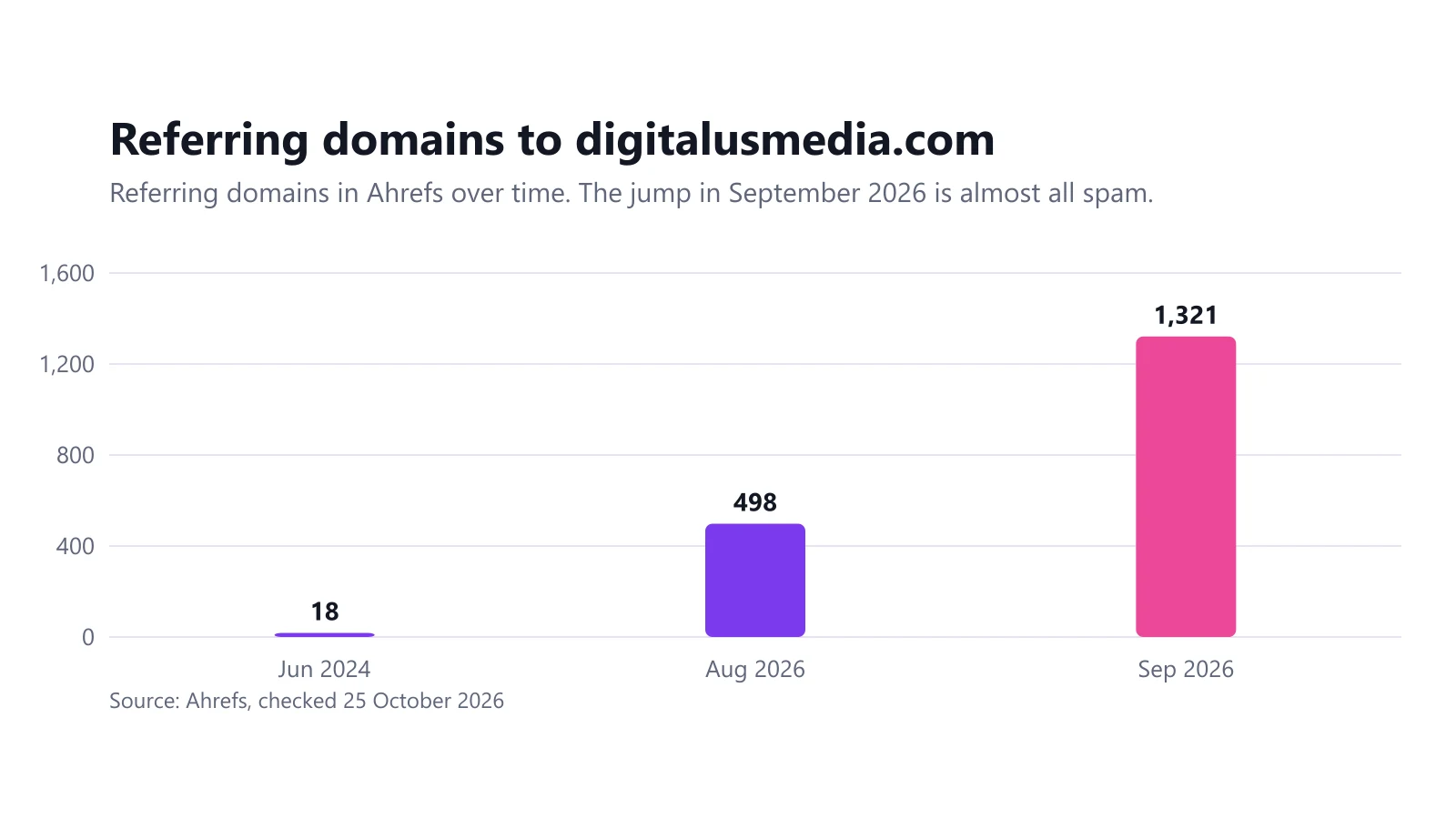
In September 2026, our own site went from 498 to 1,321 referring domains in about a month. Almost all of it was the kind of link building described above: anchors like “High Quality Dofollow Backlinks… PBN Network… Buy Backlinks” and “Premium Authority Link Building for digitalusmedia.com”, placed on numbered .xyz domains and fake “SEO checker” sites. We didn’t build those links, but it shows how link packages actually look: 1,198 worthless domains and not one real reader.
How to spot links like these in your own profile is covered in how to find toxic backlinks, and what to do if someone points them at you on purpose is in our guide to negative SEO.
How to plan link building for a small site
Our rule of thumb for a site with little authority:
- Fix the basics first. Pages that can’t be crawled or indexed won’t benefit from links.
- Create one or two linkable assets (data, a resource or a tool) before any outreach.
- Collect the relationship links you already deserve.
- Do a small amount of outreach every month rather than a big campaign once.
- Track links earned, not links sent. Count the editorial links that came in and the visitors they sent.
For what makes a single link valuable, see our guide to authority backlinks. If you’d rather have help, our link building service uses the strategies above and none of the tactics Google treats as link spam.
Frequently asked questions
How do I get backlinks to my website?
Give other sites a reason to link: publish original data or useful resources, answer journalists' questions, ask partners and suppliers for the links they would naturally give, and reach out to people who already cite similar resources.
What is white hat link building?
Earning links in ways that follow Google's spam policies: the linking site chooses to link because your page is useful to its readers. No payment for the link, no link schemes, and sponsored links marked as such.
What are the main types of backlinks?
Editorial links in articles, resource and reference links, partner and supplier links, links from profiles and directories, user-generated links in forums and comments, and sponsored links. Editorial and resource links are the ones that carry the most value.
Can you get penalized for link building?
Yes. Buying links, link exchanges at scale, private blog networks and automated link programs are link spam under Google's spam policies and can lead to a manual action or to the links being ignored.
How long does link building take to show results?
It varies with the site and competition. Earned links come in slowly, and Google needs to recrawl the linking pages before it counts them, so plan in months rather than weeks.
Related guides
Link Building and Negative SEO
Authority Backlinks: What They Are and How Sites Actually Earn Them
An authority backlink is a link from a site that is trusted and relevant in your field. Here is what Google actually measures, why DR and DA are not it, and how authority is built.
6 min read
Link Building and Negative SEO
How to Find Toxic Backlinks (and Which Ones Actually Matter)
Export your referring domains, then look at anchors, domain names, traffic and timing. Most bad links can be ignored; a few patterns need action.
5 min read
Link Building and Negative SEO
Our Site Was Hit by a Negative SEO Attack: 1,198 Spam Domains and a 98% Drop in Impressions
In September 2026 our own site went from 498 to 1,321 referring domains, and Google impressions fell from 1,393 to 24. Here is the data and what we did.
6 min read
Link Building and Negative SEO
How to Create and Upload a Google Disavow File (With Examples)
A disavow file is a plain .txt list of links you want Google to ignore. Here is the format, real examples, how to upload it, and when not to use it.
6 min read